
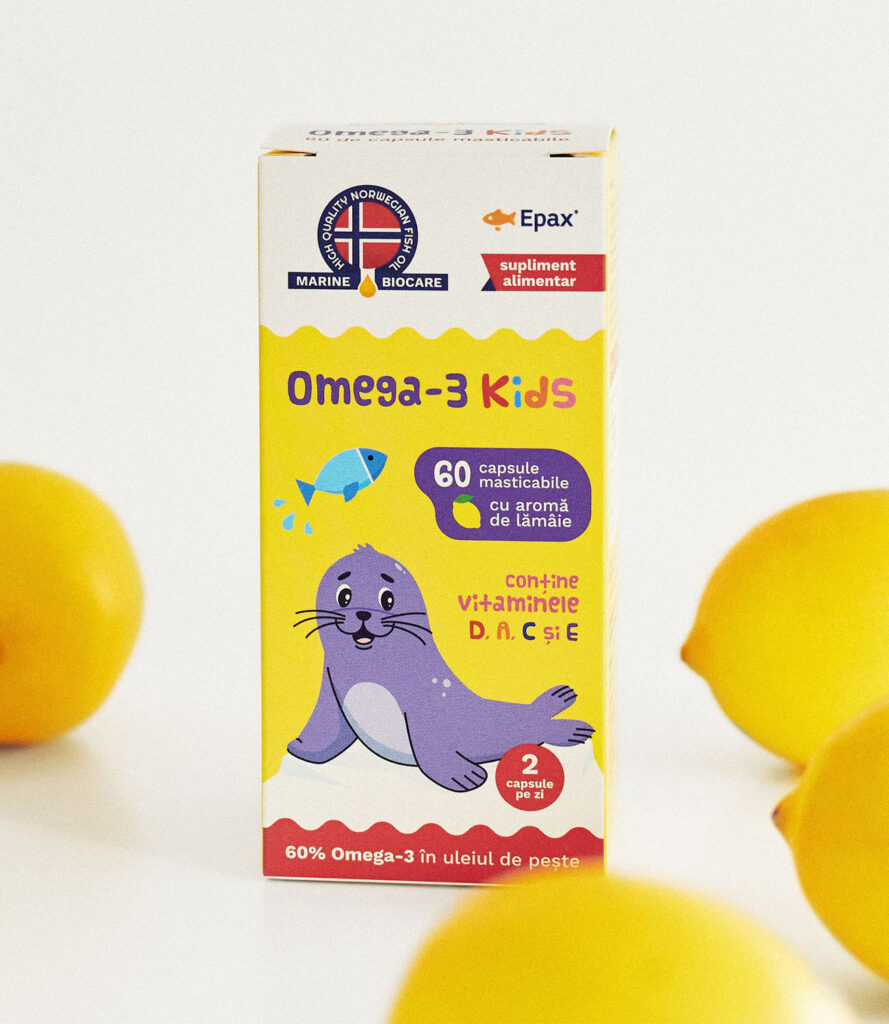
OMEGA-3 Kids
Chewable capsules
– 70% Omega-3 content in the fish oil
– Contains vitamins D, A, C, and E
A Crucial Distinction: It is essential that they are administered in their natural triglyceride form—a form that the body absorbs fully and rapidly. This means that if you take 300 mg of DHA, that exact amount is completely absorbed3.
The overwhelming majority of similar products on the market contain EPA and DHA as ethyl esters (EE)—artificial forms that are difficult to digest and have a poor absorption rate of only 20% to 40% of the administered dose. In other words, if a 1000 mg capsule contains 120 mg of DHA and 180 mg of EPA, both in ethyl ester (EE) form, the actual intake (meaning what effectively enters the body) is a maximum of 40% of the capsule’s content. Specifically, only 48 mg of DHA and 72 mg of EPA actually reach your system.
Look at it this way: To reach the minimum intake required to achieve the desired health benefits—at least 250 mg of DHA on its own to support proper brain and eye function, or a minimum of 250 mg of combined EPA and DHA to support proper heart function—you would need to swallow at least 5 of those capsules every single day.
OMEGA-3 Kids
Omega-3 polyunsaturated essential fatty acids are incredibly vital for the proper functioning of the body. Because the body cannot produce them on its own, they must be obtained externally through diet or dietary supplements. The premier source of omega-3 is marine fish inhabiting cold Arctic waters.
The most critical omega-3 fatty acids are docosahexaenoic acid (DHA) and eicosapentaenoic acid (EPA).
For children, omega-3 fatty acids – primarily DHA and, to a lesser extent, EPA – are essential for brain development, cognitive growth, and healthy vision.
DHA is the predominant type of omega-3 found in the brain’s gray matter, accounting for up to 15% of the total fatty acids in the frontal cortex.
DHA contributes to normal brain development and function (supporting focus, memory, fatigue resistance, and stress resilience), while also playing a vital role in maintaining vision.
DHA is also highly concentrated in the retina. Together with Vitamin A, it plays a crucial role in the development and proper functioning of the eyes, as well as in maintaining visual acuity.

Multiple studies conducted on various groups of children have shown that DHA plays an important role in school performance1, concluding that an adequate intake of DHA during childhood can contribute to the development of these cognitive skills2.
Conclusion: Omega-3 fatty acids (especially DHA) ensure the development, proper function, and health of the brain and eyes, and can contribute to the development of learning, reading, and planning skills in children.
The beneficial effect is obtained with a minimum daily intake of 250 mg of DHA, in accordance with the provisions of EU Regulation No. 1169/2011.
A Crucial Distinction: It is essential that they are administered in their natural triglyceride form—a form that the body absorbs fully and rapidly. This means that if you take 300 mg of DHA, that exact amount is completely absorbed3.
The overwhelming majority of similar products on the market contain EPA and DHA as ethyl esters (EE)—artificial forms that are difficult to digest and have a poor absorption rate of only 20% to 40% of the administered dose³. In other words, if a 1000 mg capsule contains 120 mg of DHA and 180 mg of EPA, both in ethyl ester (EE) form, the actual intake (meaning what effectively enters the body) is a maximum of 40% of the capsule’s content (specifically, only 48 mg of DHA and 72 mg of EPA).
Look at it this way: To reach the minimum intake required to achieve the desired health benefits—at least 250 mg of DHA on its own to support memory, focus, and eye function, or a minimum of 250 mg of combined EPA and DHA to support proper heart function—you would need to swallow at least 5 of those capsules every single day.
Ingredients
About Epax